Many landlords mistakenly believe only large, multi-storey properties need HMO licences, yet the law says any home with five or more unrelated tenants qualifies. This misunderstanding leaves thousands at risk for hefty fines and even prosecution. Grasping the true scope of HMO regulations is crucial for anyone looking to protect their investment and avoid costly legal trouble. Clarity around these rules gives landlords the confidence to let properties legally and securely.
Key Takeaways
| Point | Details |
|---|---|
| HMO Definition and Misconceptions | HMOs are defined as properties with five or more occupants from two or more households, challenging the assumption that only multi-storey properties qualify. |
| Legal Framework and Compliance | The Housing Act 2004 establishes essential management standards and safety requirements for HMOs, emphasizing ongoing education for landlords. |
| Types of HMO Licences | Key licences include mandatory, additional, temporary, and selective, each with specific criteria that landlords must understand for compliance. |
| Risks of Non-Compliance | Violating HMO regulations can lead to severe penalties, including fines, license revocation, and potential criminal charges, necessitating careful adherence to laws. |
Defining HMO Regulation and Common Misconceptions
Houses in Multiple Occupation (HMO) regulations form a critical framework designed to protect tenants and ensure safe, habitable living environments across the United Kingdom. According to gov.uk, an HMO is specifically defined as a property housing five or more individuals from two or more separate households, a definition that challenges many landlords’ existing assumptions about property classification.
One of the most pervasive misconceptions surrounds the notion that only multi-storey properties qualify as HMOs. In reality, legislation.gov.uk clarifies that the number of storeys is irrelevant to HMO status. What matters is the occupancy and household composition. This means a single-storey property with five unrelated individuals could absolutely require mandatory licensing, just like a three-storey shared house.
Key characteristics that distinguish an HMO include:
- Occupancy of five or more individuals
- Residents from two or more separate households
- Shared facilities like bathrooms or kitchens
- Potential requirement for mandatory licensing

Landlords must understand that HMO regulations are not merely bureaucratic checkboxes but essential safeguards. They mandate specific safety standards, require proper management, and ensure tenants have access to quality living conditions. Ignorance of these regulations can result in substantial financial penalties, potential legal action, and the revocation of rental licenses. Understanding What Are HMO Regulations in Property provides an excellent deep dive into the nuanced world of property management compliance.
Core Legal Framework Governing HMO Properties
The legal landscape governing Houses in Multiple Occupation (HMOs) is complex and multifaceted, rooted primarily in the comprehensive Housing Act 2004. legislation.gov.uk provides crucial insights into the legislative framework that establishes rigorous standards for HMO management, emphasizing the critical role of local housing authorities in ensuring compliance and tenant safety.
Key legislative components of the HMO legal framework include:
- Mandatory licensing requirements
- Detailed property management standards
- Safety and habitability guidelines
- Specific criteria for HMO classification
- Enforcement mechanisms for non-compliance
Interestingly, the legal framework extends beyond mere property management. legislation.gov.uk clarifies unique administrative aspects, such as council tax assessments for HMOs, which are treated as single properties for taxation purposes. This demonstrates the comprehensive nature of HMO regulations, touching on everything from physical property standards to financial administrative processes.
Landlords must recognize that the legal framework is not static but continually evolving. Compliance requires ongoing education and proactive management. The HMO Management Regulations: Complete UK Compliance Guide offers an invaluable resource for understanding the nuanced legal obligations that govern HMO properties, helping investors navigate the complex regulatory landscape with confidence and clarity.
Types of HMO Licences and Their Criteria
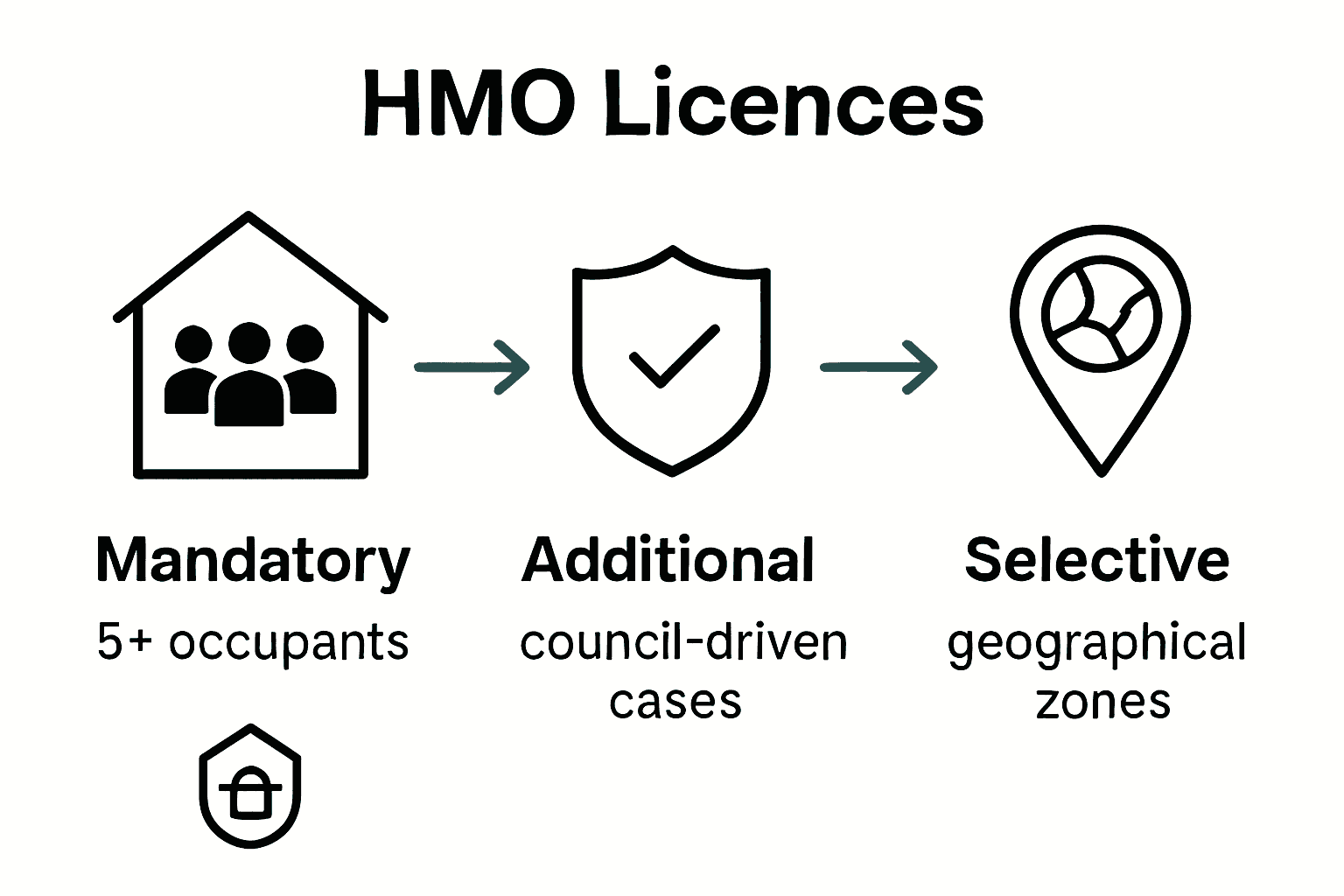
Navigating the complex world of HMO licensing requires a nuanced understanding of the different licence types available to property investors. gov.uk provides critical guidance on the two primary licensing approaches: mandatory licensing and additional licensing, each with distinct criteria and implications for landlords.
The primary types of HMO licences include:
Here’s a comparison of the main types of HMO licences and their criteria:
| Licence Type | Criteria | Typical Use Case |
|---|---|---|
| Mandatory Licensing | 5+ occupants 2+ households |
Large shared houses |
| Additional Licensing | Fewer occupants Local authority-driven |
Smaller HMOs Council determination |
| Temporary Licensing | Short-term permissions | Emergency accommodation Works |
| Selective Licensing | Specific areas or property types | Council-targeted improvement zones |
| Exemption Licences | Specialised accommodation Student halls |
University-managed student housing |
- Mandatory Licensing: Required for properties housing five or more individuals from two or more households
- Additional Licensing: Implemented by local authorities for smaller HMOs
- Temporary Licensing: Short-term permissions for specific circumstances
- Selective Licensing: Applied to specific geographic areas or property types
- Exemption Licences: For specialized accommodations like purpose-built student housing
legislation.gov.uk highlights an important nuance: certain purpose-built student accommodations managed by specific educational institutions can be exempt from standard HMO licensing requirements. This exemption underscores the complexity of licensing regulations and the need for careful, context-specific interpretation.
For investors seeking to master the intricacies of HMO licensing, the 7 Key Types of HMO Licenses You Need to Know provides a comprehensive deep dive into the subtle distinctions between different licence categories, helping landlords navigate the regulatory landscape with confidence and precision.
Mandatory Safety and Compliance Standards
HMO safety standards represent a comprehensive framework designed to protect tenants and ensure high-quality living environments. gov.uk provides critical guidance on the mandatory requirements that landlords must implement to maintain safe and habitable HMO properties.
Critical safety and compliance standards include:
- Fire Safety Measures
- Functioning smoke detectors on each floor
- Clear emergency exit routes
- Fire-resistant doors and compartmentation
- Minimum Room Size Requirements
- Minimum floor space per occupant
- Adequate natural lighting and ventilation
- Waste Management Protocols
- Proper waste disposal systems
- Regular cleaning and maintenance of shared areas
- Electrical and Gas Safety
- Annual electrical installation checks
- Regular gas safety certification
- Structural Integrity
- Regular property maintenance
- Compliance with building regulations
legislation.gov.uk emphasizes that these standards are not mere suggestions but legal requirements under the Housing Act 2004. Landlords must view these compliance standards as fundamental obligations, not optional recommendations. Non-compliance can result in significant penalties, including fines, license revocation, and potential legal action.
For investors seeking a comprehensive understanding of these complex requirements, the Essential HMO Licensing Tips for UK Property Success provides an invaluable resource for navigating the intricate landscape of HMO safety and compliance standards.
Landlords’ Responsibilities and Tenant Rights
The relationship between HMO landlords and tenants is governed by a complex legal framework that balances protecting tenant welfare with defining clear landlord obligations. gov.uk provides comprehensive guidance on the intricate responsibilities and rights that define this critical relationship.
Key Landlord Responsibilities include:
- Maintaining property safety and habitability
- Ensuring all required licensing and compliance standards are met
- Conducting regular property maintenance
- Providing clear communication about tenancy terms
- Respecting tenant privacy and legal occupancy rights
- Addressing repair and maintenance requests promptly
legislation.gov.uk emphasizes that tenant rights extend beyond basic accommodation. Tenants are entitled to live in properties that meet rigorous safety standards, with the legal ability to report violations and seek recourse if landlords fail to meet their fundamental obligations. This creates a balanced ecosystem where both parties have clear, enforceable expectations.
For landlords seeking a comprehensive understanding of these complex legal dynamics, the 8 Essential Tips for Your HMO Legal Checklist 2025 offers an invaluable resource for navigating the nuanced landscape of HMO tenant-landlord relationships.
Risks, Penalties, and Enforcement Actions
Non-compliance with HMO regulations represents a significant legal minefield for property investors, with potential consequences that extend far beyond simple monetary fines. gov.uk provides critical insights into the escalating risks landlords face when failing to meet regulatory standards.
Potential Enforcement Actions include:
- Financial penalties up to £30,000
- Mandatory licensing revocation
- Criminal prosecution
- Banning orders preventing future property management
- Compulsory purchase of non-compliant properties
- Personal liability for tenant safety breaches
- Potential imprisonment for severe violations
legislation.gov.uk emphasizes that enforcement mechanisms under the Housing Act 2004 are designed to be progressively punitive. Local authorities have extensive powers to investigate, penalize, and prevent ongoing non-compliance, treating regulatory breaches as serious legal infractions that directly impact tenant welfare and community safety.
To navigate this complex regulatory landscape and minimize potential risks, landlords should consider consulting the Complete Guide to HMO Regulations UK 2025, which offers comprehensive strategies for maintaining full legal compliance and avoiding potentially catastrophic enforcement actions.
Stay Ahead of HMO Legal Duties with Expert Support
Managing an HMO property comes with complex legal duties and strict safety standards that every UK landlord must meet. This article highlights important challenges such as understanding mandatory licensing, compliance with safety regulations, and avoiding costly enforcement actions. Navigating these requirements can be overwhelming but failing to comply risks heavy fines and licence revocation. The burden of managing detailed landlord responsibilities, tenant rights, and evolving regulations demands clear guidance and reliable support.
If you are an investor or landlord aiming to turn these challenges into opportunities, AgentHMO offers a tailored platform to simplify your property journey. Discover trusted HMO-related services like property management experts and estate agents specialising in HMOs nationwide. Whether you want to buy, sell, lease, or ensure your property meets all legal standards, our comprehensive resources empower you to make informed decisions. Act now and connect with a large community of HMO professionals to safeguard your investment and fully comply with regulations today at AgentHMO.
Frequently Asked Questions
What is an HMO and how is it defined?
An HMO, or House in Multiple Occupation, is defined as a property housing five or more individuals from two or more separate households. This classification is based on occupancy and household composition rather than the number of storeys in the property.
What are the key licensing requirements for HMOs?
Landlords must comply with mandatory licensing if their property has five or more occupants from two or more households. Additional licensing may be required by local authorities for smaller HMOs, and there are also temporary and selective licensing types for specific circumstances.
What safety and compliance standards must landlords adhere to for HMOs?
Landlords must comply with mandatory safety standards, including fire safety measures, minimum room size requirements, proper waste management protocols, and regular electrical and gas safety checks to ensure tenant safety and property habitability.
What are the penalties for non-compliance with HMO regulations?
Non-compliance can lead to significant penalties, including fines up to £30,000, mandatory licensing revocation, and even criminal prosecution. Local authorities can take enforcement actions to address breaches, emphasizing the importance of adhering to regulations.
Recommended
- 8 Essential Tips for Your HMO Legal Checklist 2025
- Complete Guide to HMO Regulations UK 2025
- HMO Management Regulations: Complete UK Compliance Guide
- The Essential Guide to HMO Compliance UK
- Multiple occupation: Enhance HMO Appeal with EPC Checks
- Commercial Property Law UK: Complete Guide | Ali Legal